Coaching is a rapidly growing field of working with people that is applied in both personal and professional life. There are many approaches and specialisations, and one of the most practical and at the same time frequently used models is operational coaching. It is a method focused on concrete actions, measurable goals and visible results.
In this article, we take a detailed look at what exactly operational coaching is, what its main tenets are, how it differs from other coaching approaches, and when it is a good idea to opt for such a process. The text is factual and specialised, drawing on practitioner experience and applied knowledge in organisations.
What is operational coaching?
Operational coaching is a form of coaching work focused on supporting the client to achieve very specific tasks and goals. The coach focuses primarily on the level of operationalthat is, one that is concerned with the day-to-day activities, the daily duties and the strategies needed to successfully achieve the desired result.
Example: a client reports that they need to write a thesis, prepare a presentation for the board or implement a new process in the organisation. The task is clearly defined and the role of the coach is to help plan the next steps, reinforce motivation and monitor progress.
Unlike life coachingwhich focuses on wider life changes, values and personal satisfaction, and from business coaching, which includes the development of leadership and strategic competences, operational coaching is mainly concerned with practical 'here and now' activities.
Remember that in the Meeting Group you can benefit from programmes and Trainingwhich offer the required number of hours of personal development in line with the EMCC certification pathway. Are you interested in executive coaching? Find out what is price of executive coaching training or click and check what is price of a coaching session on offer from the Meeting Group.
Key features of operational coaching
- Specific objective - the process focuses on one clearly defined task, e.g. preparing a project, implementing a campaign or improving work efficiency.
- Measurable effects - the success of the session is assessed through the client's real actions and results, not just their reflection or sense of change.
- Short time horizon - Operational coaching usually lasts from a few to a dozen sessions, focusing on the rapid implementation of change.
- Action-oriented - the key element is to put strategies and plans into practice, not just to analyse or diagnose the problem.
- Developmental character - although the process is highly task-oriented, it also develops the client's competences - teaching planning, organisation, perseverance and self-discipline.
Operational coaching versus other types of coaching - psychological coaching, business coaching, etc.
To better understand the specifics of operational coaching, it is useful to contrast it with other popular coaching approaches:
| Type of coaching | Characteristics | Main objectives and area of application |
| Operational coaching | It focuses on day-to-day activities and strategies for achieving specific tasks. | Delivering a clearly defined project, improving work organisation. |
| Life coaching | Based on the client's values and life goals. | Personal development, satisfaction, dealing with emotions and relationships. |
| Business coaching | Associated with professional roles, particularly managerial and leadership roles. | Development of professional competences, team management, leadership. |
| Transformational coaching | Working towards a profound change in identity and self-perception. | Increasing self-awareness, discovering potential, self-realisation. |
| Psychological coaching | It focuses on changing beliefs and thought patterns. | Working on emotions, beliefs, difficult reaction patterns. |
As you can see, operational model is the most 'practical' and task-based, focusing on everyday challenges and concretes rather than philosophical or existential questions.
How does the coaching process work?
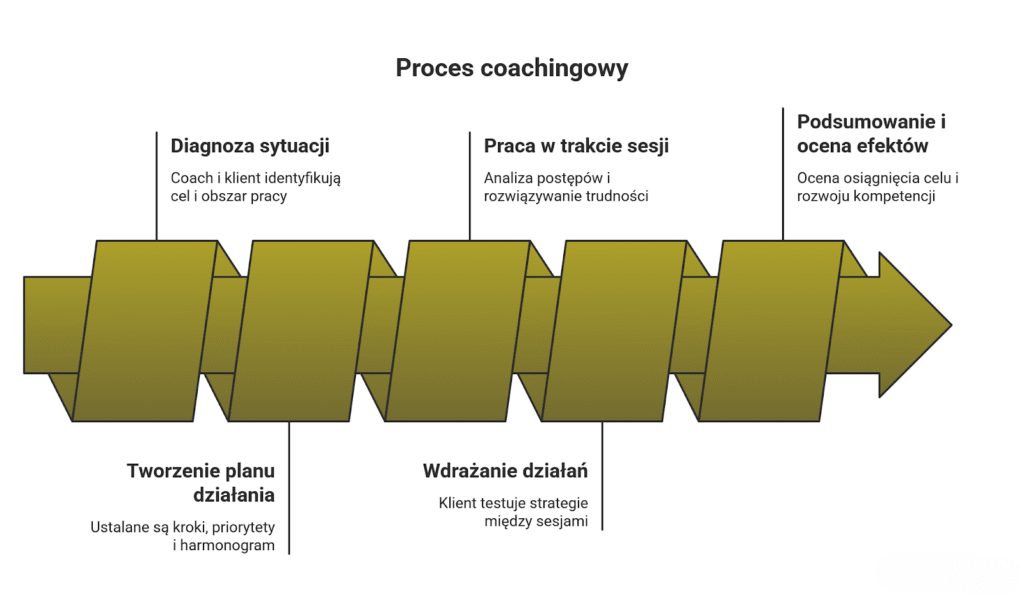
The process usually consists of several key stages:
- Diagnosis of the situation - The coach, together with the client, precisely defines the goal and the area in which the coaching work will be carried out.
- Creating an action plan - the next steps, priorities and timetable are established.
- Work during the session - The client analyses his or her progress and the coach asks questions and supports in solving ongoing difficulties.
- Implementation of actions - the client undertakes specific activities between sessions, testing the strategies developed in practice.
- Summary and evaluation of effects - to check whether the objective has been achieved and which competences have been further developed.
When is it worth choosing operational coaching?
Operational coaching will work particularly well in situations where:
- the client needs support in implementing one well-defined task,
- What counts is quick results and measurable outcomes,
- there is a problem with work organisation, punctuality or motivation,
- help is needed to draw up a step-by-step action plan,
- it is important to increase personal effectiveness in a specific area,
- someone is preparing for an important event (e.g. public speaking, job interview, exam).
Operational coaching and professional development
Although this working model focuses on operational tasks, its impact goes further. The client not only completes a specific project, but also develops their organisational skills, strengthens their sense of agency and gains experience in dealing with obstacles.
This makes operational coaching a development - prepares you for the challenges and increases your readiness to take on further goals. In this sense, it becomes complementary to approaches such as business coaching or life coachingwhich have more holistic dimension.
Advice from a specialist - Meeting Group
"From our experience working with clients, we have found that the operational coaching is particularly effective in situations where someone is facing a specific challenge and feels stuck. The coach's role then is not to give ready-made solutions, but to support the client in creating a workable plan and maintaining motivation. It is worth remembering that even small but consistent actions lead to big results. That's why operational coaching is an excellent tool not only for solving current problems, but also for developing sustainable habits of effective action."
Want to know the ins and outs of more than just operational coaching? Check out the offer of the Meeting Group
Coaching is much more than a tool for achieving goals - it is a process that supports personal, professional and relational development. If you want to learn not only the basics operational coachingbut also delve into its deeper layers - such as strategic, developmental or transformational coaching - check out the Meeting Group's offering.
Our training programmes cover a wide range of approaches, techniques and models for working with clients, all in line with EMCC international standards. We teach practically, inspiringly and with the przyszły of professional coaches in mind.
During the certified coaching training such as 5-day accredited Executive Coaching workshop Among other things, you will learn how to use specific transactional analysis tools.
Select training offer Groups Meet and develop your career in the coaching world!
Summary
Operational coaching is a practical and highly effective method of coaching work that is goal- and task-oriented. It differs from other approaches in its task-oriented and short-term nature, but at the same time has a dimension of developmentas it allows you to acquire competences that are useful for your next professional and personal challenges.
If you are looking for support with a specific project, want to improve your efficiency or you need to organise the activities in a particular area, operational coaching may be the best choice for you.
FAQ - Frequently asked questions
How does operational coaching differ from other coaching approaches?
Operational coaching focuses on change at the level of behaviour and specific tasks. Unlike holistic coaching, which encompasses the broader context of life and personal development, or crisis coaching, which combines elements of crisis intervention and classic coaching, the operational process focuses on achieving a clearly defined goal in a short time frame.
Can operational coaching support leaders and managers?
Yes. In working with leaders and managers, as in executive coaching or management coaching, the aim may be to improve the organisation of work, to improve the way decisions are made or to enhance effectiveness in project leadership. This approach is also sometimes used by człons of boards of directors and key representatives of the highest levels of management in an organisation, including CEOs.
How does operational coaching fit in with other forms of coaching?
The coaching process can be combined with other strands - such as team coaching, which supports team effectiveness and develops teamwork competencies, or individual coaching, which focuses on personal goals. Business coaching, which focuses on professional areas, or career coaching, which helps to find one's way through personal and professional life, is also popular.
What is the role of the coach in this approach?
The coach in the operational process is based on trust in the coach-coachee relationship and faith in the client's resources. During the coaching session, he or she helps the client to deal with the problem and find the best solution without imposing his or her own opinions.
Does operational coaching consider deeper levels of work?
Although it is a task-based approach, in practice it can also touch on deeper levels of development - similar to competency coaching or approaches inspired by solution-focused therapy. In this way, the client not only learns to address current issues, but also develops the skills needed to deal with subsequent challenges.