


The HR department has been set up to support managers in engaging employees to achieve their goals. This support can be carried out at various stages: from hiring the right employee through developing their competencies to the point of separation. However, human resources (HR) management should not be about saving, but supporting candidates, employees and managers. Is this the case? Find out what qualities an HR professional should have.
What does typical human resources management look like?
The position of facilitator, or de facto facilitator of someone's work, carries a great risk of crossing the thin line that runs between helping and helping out. In order to fulfil the objectives for which the HR department was created, three conditions must be met:
- continuous education of employees at all levels of the organisation about what the HR department can deliver,
- continuous verification of incoming demand,
- very clear contracts within the company so as not to perform duties for other employees.
This approach is not only good for motivating employees, but offers numerous benefits already at the stage of employer interviews, recruitment, development paths and the company's image in the market. Check out the details HR masters programme and see how you can develop your HR competences.
HR from a psychological perspective
The topic of HR management in psychology is viewed from many perspectives. Often we start to become interested in it when we see the long-term effects of overstepping the mark: a decline in productivity, a feeling of being exploited or a failure to see the meaning of one's work.
How do we cross this boundary?
What the HR department does and what it should do - SKOK WITHOUT SPADOCHRONS
The first crossing is akin to jumping into an abyss without a parachute. It is a job without a clear agreement on the responsibility for individual tasks - both on the part of the HR professional and on the part of the people with whom he or she works (manager, HR manager, and człons of teams).
If you want to see if you are jumping in unprotected, make sure you have clear and unambiguous agreements:
- What you are responsible for and what you are not.
- What is the other party's responsibility and what is not.
- What is the objective or outcome of the collaboration?
- What are you to do when the other party does not fulfil what you have agreed to?
- What is the other party to do when you fail to fulfil your obligations or part of them?
- What information is crucial to you, when and how you want to receive it, and conversely, what information is important to the managers you work with.
HR work - What shouldn't it look like? THE SIN OF INDULGENCE
A more developed HR department is unlikely to experience work without a clearly defined agreement on what the tasks consist of extenso. In contrast, a second type of transgression of the boundary between helping and saving occurs, which could be called the 'sin of letting go'. It occurs when the contract - although clear at the beginning - begins to expand, narrow and/or ceases to be respected. Usually, the first złampering of the contract occurs with a good intention - to make it quicker, easier, but actually starts doing things without agreement or for someone. Later on, this extends to more people with whom the cooperation runs, and in the end the contract becomes like a worthless crumpled paper. The second dimension of this sin is when the HR department does not react when someone subtly starts to circumvent the contract or when tasks or expectations arise for which we were not agreed. This is how the way to move from helping to saving is opened up.
HR specialist in a company - How to check the competence of a candidate, an employee - CHECKLIST
If you want to do a brief review of whether the HR department, the unit's operations, or you personally have let go of working to agreed rules and are entering the risky zone of working based on guesswork, in internal compulsion or frustration, saving someone from their slip-ups, review the checklist below:
- Have you been silent about feedback that you received material that was not what you agreed to?
- Did you say nothing when you received the material late?
- In the face of people not doing their part of the work, did you happen to do it for them without agreeing with them?
- Have you ever made a decision yourself that you really should have consulted (e.g. not to take up someone else's time or waste energy on unnecessary discussions)?
- Did it happen to you that you did not do something, did not come to a meeting, even though you had made an appointment to do so (e.g. because it was less of a priority for you, uninteresting) and you did not inform them about it?
- During the course of a task, did you discover that you needed something or that something was getting in the way of you completing it effectively and you did not report it?
- Have you done your work under different conditions than agreed (with fewer people, in less time, on a smaller budget), even though no one has actually had a serious discussion with you about it?
- Are you acting in an area that is not your responsibility or for which you have no responsibility and have not agreed with others?
- Do you react to things that are not directly addressed to you as a need or request, but are, for example, an outpouring of grievances, frustrations or complaints about something or someone?
- Do you take on any responsibilities even though you do not have the competence or knowledge to help in this area?
- Do you work in an area because you feel an inner compulsion and perceive a given situation as one from which there is no other way out but to help?
Motivation of company employees - WHY is it wrong to rescue?
If you answered affirmatively to a minimum of five questions, in AT language this means that you are at risk of stepping into the role of the Rescuer from the position of an HR professional to help and support the people they work with.
Rescuer is a concept taken from Karpman's (1968) concept - the Dramatic Triangle reflects how we can play dramatic roles (Victim, Persecutor, Rescuer) in psychological games. Everyone involved in the Dramatic Triangle will always end up in a losing position - there are no winners in this game....
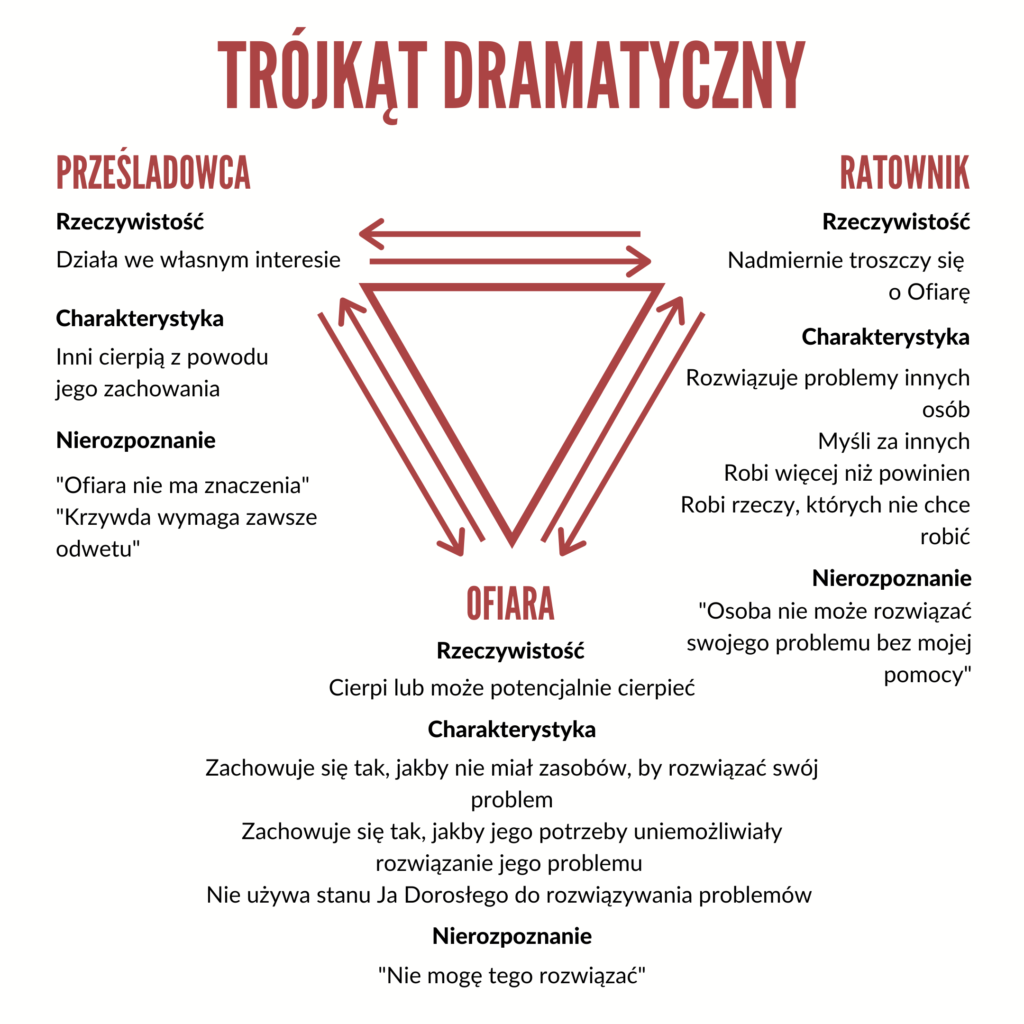
People in the role of Rescuer rescue people in the role of Victim to unconsciously satisfy the need for self-esteem, e.g. through signals that one is needed or indispensable.
Rescuers express concern for the Victim by taking over thinking and problem solving for them, thus overlooking the ability of those in that role to assess the situation, take appropriate action and ask for help when needed. As a result, as Claude Steiner pointed out, Rescuers are either doing something they don't want to do, or doing more than they should. Steiner suggests that rescuing is an activity in which we overlook our awareness of what we want and need, and lose judgement about what an equitable distribution of responsibilities is. This is what HR should be wary of.
Stepping into any of the roles in the Drama Triangle is equivalent to triggering a psychological game. These roles can change. For example, Rescuers who get tired of having their boundaries crossed and their needs unmet may feel persecuted and frustrated, eventually persecuting the Victim - that is, they will enter the role of the Persecutor (this is how the game of 'Look how hard I tried' goes). Otherwise, they may also enter the role of the Victim (for this change the game plays out: "I'm just trying to help you", "Why don't you...", "At your service").
You can read more about psychological games in the classic AT handbook by Ian Stewart and Vann Joines Transactional Analysis Today by Rebis or the well-known book by the founder of transactional analysis Erick Berne What people play PWN Scientific Publishers, which the company's HR department should study carefully.
From soft HR to hard HR - THE WINNING TRIPLE - or where is the way out of this drama?
The way out of the Dramatic Triangle is to move into the roles and skills of the Winning Triangle, as defined by Acey Choy (1990). By changing from a destructive role to a constructive role, the losses incurred in the Dramatic Triangle cease and there is no psychological gaming or costs associated with it. The Winning Triangle allows the person to function independently. In this case, the Persecutor takes on the role of the Assertive person, the Victim the Vulnerable person and the Rescuer steps into the role of the Protector.

Carers in the Winning Triangle differ from Rescuers in the Dramatic Triangle in that they look at people who need help, not as Victims unable to cope with a difficult situation, but as someone who needs support at the time. They recognise that vulnerable people, like all people, have the capacity to think for themselves, solve problems and make their own decisions independently. Caring people, unlike Rescuers, ask what the person needs, what kind of help they are ready for. If they wish, they can offer help of a certain nature. They monitor their own needs and feelings, so they can responsibly decide if and how much they want to be available to the vulnerable person. If they don't want to, they know they can refuse without feeling guilty. This 'putting themselves first' allows them to avoid feeling that someone is insulting them, while at the same time they avoid stepping into the role of the Persecutor.
A skill needed at the caring apex of the Winning Triangle is listening, which allows the caring person to be adequately available to the vulnerable person, something HR should be particularly sensitive to.
Assertive people, like Persecutors, use their energy to satisfy their own needs and defend their rights. However, unlike Persecutors, they are not interested in proving their superiority or punishing Victims.
The Assertive role is an attitude of willingness to assert one's own rights and change adverse situations. Such a person realises that making assertive changes can cause distress to people whose plans depended on the status quobut they do not relish the anxiety or distress of doing so. People using this role see negotiation as part of the process of meeting their needs while maintaining an OK-OK position.
The key skills needed at this apex of the Winning Triangle are assertive behaviour and win-win negotiation, which HR should set at the top of the tasks to be completed.
Vulnerable people in the Winning Triangle differ from Victims in that they engage in problem solving, using their ability to recognise their feelings as information for necessary change. When solving a problem, they see many options: asking for help, using their own or others' resources, asking for support. They also know that if the person they are asking says no, they do not have to run away into helplessness, but can still look for other ways to meet the need.
The skills needed at this apex of the Winning Triangle are problem-solving skills.
HR in the company - How to manage work and people (human resources)?
HR professionals I know sometimes launch into a series of defensive questions in such a situation, such as "Then what should I do?".
First - create a very precise framework for your work. Clarify what you are responsible for, what you are accountable for, what are the most important objectives of your work. Remember that as HR professionals we support managers to manage, not manage for them. In AT we call this area contracting, which HR can also use to organise work.
Second - talk to people who are not fulfilling the arrangements about why this is the case and ask how to help them. Perhaps they need other tools, some change in the arrangements or to address an urgent issue.
Thirdly - if the previous actions would not work - set clear boundaries and refuse to work with such people and only work with those who fulfil their part of the responsibility.
If the consequences of these people not doing their job are threatening to the organisation, a conversation about it should be organised with them and their supervisors.
Human Resources - Last request
I have another conclusion from observing the work of HR-people - often the HR department has another important area of its work which is to continuously teach people in the organisation what their role is. Otherwise, the HR person starts to crank out, solicit and try more than the other party and step by step ceases to be a partner. Looking for people management training? Find out about our training courses: Manager's Academy i Individual training.
Literature:
Berne E. (1987). What people play at. The psychology of human relations, Warsaw: PWN.
Clarke J.I. (1982). More ideas, fewer games. "Transactional Analysis Journal "12, 121-122.
Choy A., The Winner's Triangle, Vol.20, No. 1, January 1990.
Clarke J.I. (1982). More ideas, fewer games. "Transactional Analysis Journal "12, 121-122.
Karpman S. (1968). Script drama analysis. "Transactional Analysis Bulletin "7 (26), 39-43.
Stewart I., Joines V. (2016). Transactional analysis today, Poznań: REBIS.