What is coaching? This question is being asked by more and more people - both in the business world and in a private context. Coaching is today one of the most popular methods of working on oneself, a team or an organisation. It is not just a fad, but above all an effective form of support that combines elements of psychological practice, development methods and a partnership approach with the client.
In this article, we explain exactly what coaching is, the types of coaching, what the coaching process looks like and why it is becoming increasingly important in the professional and personal world.
What is coaching?
In the most general terms coaching it's development processwhich aims to discover and develop potential customer. Unlike counselling or training, the coach does not give ready-made solutions. Instead, he or she supports the client in discovering his or her own resources and ways of doing things.
The key elements of coaching are:
- partnership relationship between coach and client,
- a focus on przyszłness and opportunities,
- development of competences necessary for effective action,
- working in an atmosphere of trust and empathy,
- individual sessions or grouptarget-oriented.
Coach acts as coach mental and developmental, which aims to direct the client on the best solutions, increase their self-awareness and help them break down barriers.
Remember that in the Meeting Group you can benefit from programmes and Trainingwhich offer the required number of hours of personal development in line with the EMCC certification pathway
The role of a coach - how does it differ from an advisor, coach and mentor?
Many confuse coaching with counselling or mentoring. However, the differences are important:
- Advisor - provides ready-made solutions, analyses data and recommends specific actions.
- Mentor - shares his own experience, shows the way forward based on his practice.
- Coach - does not give ready-made answers. Its role is to ask questions, stimulate reflection and support the client in making decisions for themselves.
It is the partnership nature of the coaching relationship distinguishes coaching from other forms of support.
Motivational coaching and other types of coaching
Coaching is a broad field, encompassing different areas of life - from professional work to personal development. We distinguish between the following, among others types of coaching:
| Type of coaching | Description | Application |
| Individual coaching | A one-to-one relationship focused on the client's objectives. | Personal development, confidence work, stress management. |
| Group coaching | Working in a group of people who don't necessarily know each other. | Peer inspiration, learning from the experiences of others, motivation. |
| Business coaching | Focused on objectives professional and organisation. | Development of managers, leaders, teams, performance improvement. |
| Life coaching | In Polish it is life coaching. | Personal development, improved life satisfaction, better relationships. |
| Motivational coaching | Targeted at increasing motivation and energy for action. | Helping people who have difficulty setting and achieving goals. |
| Agile coaching | Working with teams in a spirit of agility and flexibility. | Organisations implementing agile methods, project management. |
Coaching in business
Business coaching is a process that is particularly valued in the corporate environment. Companies invest in this form of support because it brings tangible benefits to the organisation.
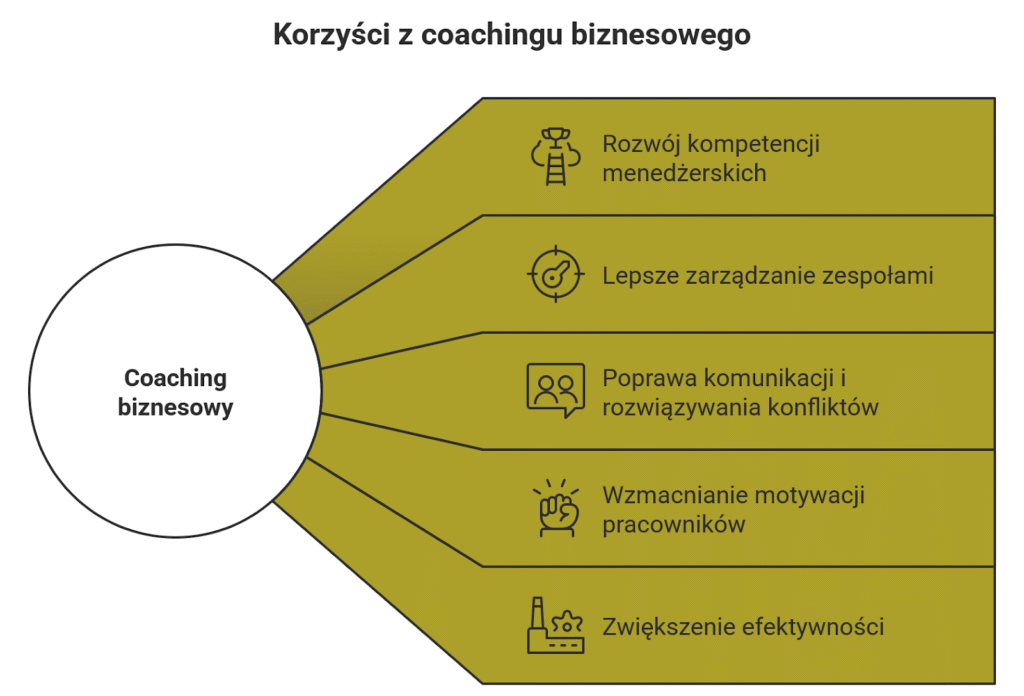
Most frequent targets coaching in business are:
- development of managerial competence,
- better management of teams,
- improving communication and conflict resolution,
- strengthening motivation employees,
- increasing the efficiency of entire departments and companies.
Through coaching, managers and leaders learn how to reach strategic goals and build a culture of cooperation. Business coaching is not only employee development, but also an investment in the long-term success of the organisation.
Life coaching and personal development
In addition to its work in the business environment, coaching is of great importance in the private sphere. Life coaching is a process in which the client focuses on his or her life personal - values, aspirations and a sense of fulfilment.
The most common topics for life coaching sessions are:
- finding a work-life balance,
- increasing life satisfaction,
- improving family and partner relationships,
- development of creativity and self-awareness.
This is a great form of support for people who want to develop your potential and find new energy for action.
The coaching process - what does a session look like?
Coaching process is usually structured, although each session is tailored to the individual needs of the client.
Most often it looks like this:
- Definition of the objective - the client, with the help of the coach, defines what he or she wants to achieve.
- Resource analysis - The coach supports in identifying strengths and limitations.
- Action plan - jointly develop a step-by-step strategy.
- Coaching sessions - regular individual or group meetings.
- Evaluation - evaluation of effects, reflection and possible adjustments.
During the process, the client gradually discovers new possibilities and strengthens the competenceswhich allow it to operate more effectively.
Coaching versus psychology and work techniques
Although coaching is not therapy, it draws inspiration from psychology and methods of working with the czł person. It makes use of various techniques, among others:
- open questions (thought-provoking),
- visualisation exercises,
- metaphorical games,
- tools for planning and monitoring progress.
The coach uses techniques as an add-on, and the core is always partnership relationship with the customer and working together on goals.
Advice from a specialist - Meeting Group
"Coaching is often confused with counselling or mentoring, meanwhile its strength lies in the client discovering the best solutions for themselves. The role of the coach is direct process, ask questions and create space for reflection. In our work with organisations, we see that professional coaching significantly increases the effectiveness of managers and entire teams. It is worth remembering that this is not quick advice, but development process, which has long-term effects."
Why become a coach?
The path to being a coach is not only a profession, but also a path of self-development. To become a coach, it is worth going through the relevant training, postgraduate studies and practice. Key points are:
- communication skills and empathy,
- knowledge of psychology and business,
- experience of working with people,
- readiness for continuous learning.
For many, a career in coaching is also a chance to combine work with passion - supporting others in achieving their objectives and capacity building.
Do you want to become a certified coach? You can do it with the Encounter Group!
Thinking about a career in coaching and wondering where to start? The Meeting Group is a proven partner on your way to becoming a a certified coach. We offer professional training in line with EMCC international standards that will prepare you to work with clients at the highest level. Whether you are just starting out or want to deepen your skills - with us you will find the support, experience and practical knowledge you need to spread your wings as a coach.
During the certified coaching training such as 5-day accredited Executive Coaching workshop Among other things, you will learn how to use specific transactional analysis tools.
Select training offer Groups Meet and develop your career in the coaching world!
Summary - coaching what is it?
Coaching is a comprehensive and effective way of working on development - both in the world of professionalas well as in life personal. Thanks to various types of coaching (individual, group, business or motivational), each client can find the right form of support.
Whether we are talking about life coachingwhich focuses on values and satisfaction, or on business coachingwhich strengthens organisations - the foundation remains partnership relationship, a focus on przyszłness and a belief in the client's potential.
It is a method that allows not only reach goals, but also to build lasting change and develop competences useful in every sphere of life.
FAQ - The most common questions about coaching
1. what is coaching?
Coaching involves a partnership between coach and client (coachee), in which the aim is to discover potential and support the achievement of set goals. It is interactive development processin which the coach does not give advice or ready-made solutions, but motivates to action and supports you in discovering your own ways of doing things.
2 What does a coach do and who is a coach?
A coach is a development specialist whose task is to support the client in the change process. The coach helps the client better understand yourself, your capabilities and your limitations. As opposed to an advisor or mentor, coach does not advisebut supports you in reflecting and making independent decisions.
3. how does coaching work?
Coaching is a process that is based on conversation, asking questions and working with the client's resources. Through this, the client develops self-awareness, gains new perspectives and learns skill developmentwhich help him to achieve his professional and personal goals.
4 What is the difference: mentoring versus coaching?
- Mentoring is the transfer of knowledge and experience - the mentor shows the way, based on his/her own practice.
- Coaching is a process in which coach and client discover the best solutions together. Coaching and mentoring They share a common goal of promoting development, but differ in method.
5. what does the coaching process look like?
A typical process includes:
- Defining the objectives set.
- Analysis of the client's resources and obstacles.
- Regular individual coaching sessions or group meetings.
- Use of appropriate tools and techniques.
- Evaluation and reflection.
6. What are the varieties of coaching?
In practice, a number of specialisations stand out, including:
- business coaching,
- team coaching,
- life coaching,
- diet coaching (targeted at building healthy habits),
- agile coach (supports organisations in implementing agile working methods).
7. How does coaching help in work and private life?
Coaching helps to the change process, increasing self-confidence, better time and stress management, as well as in building relationships and achieving professional success. W in the case of team coaching The result is improved collaboration, communication and increased efficiency across the group.
8. What qualities should a good coach have?
Good coach should have:
- active listening skills,
- empathy and the ability to ask pertinent questions,
- knowledge and experience in coaching,
- knowledge of techniques used in various coaching streams,
- professional preparation, confirmed, for example, by certification (e.g. International Coaching Federation).
9. how does coaching differ from training or counselling?
Training or counselling provides ready-made knowledge and solutions. Coaching, on the other hand focuses on the client's resources and potential. This skill development process, rather than knowledge transfer.
10. What tools and techniques does the coach use?
A variety of techniques are used in coaching, including: open-ended questions, metaphor games, coaching cards, visualisation exercises or working with SMART goals. The most important thing, however, remains that the coach uses tools in a way that is tailored to the individual client and their situation.